



Our choice: Oral-B Pro 1 Series
The Pro 1 Series is the more affordable option and cleaned my teeth just as well.
Brush heads for the iO2 are about twice the price of those for the Pro 1, which over the space of three years makes a big difference to the total cost.
Although the iO2 offers a few small advantages they don’t outweigh its higher cost.


When to choose the iO2
The main reasons to choose the iO2 over the Pro 1 would be if you prefer the look and feel of the iO range, or if you need a brush with a long battery life.
The iO2 has the best battery life of any Oral-B brush I've used. In testing it lasted 37 days, whereas the Pro 1 lasted 10 days. This is quite a difference, but unless you don't have the means to charge your brush frequently, it's not worth paying too much attention to.

Key Differences: Pro 1 vs iO2
The following table lists the key differences between each brush.
A more detailed list and explanation of the differences can be found beneath the comparison table.
| Find out more |
| Electric Teeth Rating |
| Cleaning Action |
| Number of cleaning modes |
| Brushing intensities |
| Timer |
| Pacer |
| Pressure Sensor |
| Battery life |
| Battery type |
| Number of heads included |
| Travel case included |
| Bluetooth connectivity |
| Position tracking |
| Noise |
| Warranty |
| Buying options |
|
Our Choice
|
|
|---|---|
| Review | Review |


(4.5)
|
(4.4)
|
| Oscillating-rotating & pulsating (3D) | Linear Pulse Drive |
| 3 | 3 |
| - | - |

|
|
| 30 second quadpacer | 30 second quadpacer |
|
|
|
| 10 days | 14+ (plus) days |
| Rechargeable Nickel Metal Hydride (NiMH) | Rechargeable Lithium-Ion (Li-Ion) |
| 1 | 1 |
| - | - |
| - | - |
| - | - |
| 72dB | 72dB |
| 2 years | 2 years |
- Cleaning/brushing action
- The iO2 uses a different type of brush motor than the Pro 1.
- Handle design/colours
- The iO2 has a matt finish to the handle vs the gloss finish on the Pro 1.
- The Pro 1 has a dimpled texture to the back of the handle that the iO2 does not have.
- The iO2 has a larger concave power button than the Pro 1.
- The iO2 has an LED for the battery charge status and pressure sensor built into the power button. The Pro 1’s LED is located towards the bottom of the handle.
- The iO2 is available in 4 colours (white, black, pink & green) vs the 3 colours of the Pro 1 (black, blue & pink).
- Marginal weight and handle size differences.
- Cleaning modes
- Both models have a Daily Clean and Sensitive mode. However, the Pro 1 has a Whitening mode whereas the iO2 has Super Sensitive.
- The default cleaning mode on the iO2 can be changed. it can’t on the Pro 1.
- Brush heads
- The iO2 uses a different brush head style exclusive to the iO Series.
- The iO2 comes with 1 x Gentle Care brush head compared to the 1 x CrossAction supplied with the Pro 1.
- Pressure sensor
- The iO2 illuminates an LED in the power button with a red light when the pressure sensor is activated. The Pro 1 has a sensor but does not offer a visible alert.
- Battery
- The iO2 has a 37 day battery life from the Lithium-Ion battery vs the 10 days from the Pro 1’s Nickel Metal Hydride battery.
- Price
- The iO2 is more expensive with a retail price of £100 compared to the £70 of the Pro 1 Series.
- The cost of replacement brush heads for the Pro 1 is half that of the iO2.
Please note. Every effort is made to ensure the key differences listed are correct, but these differences are subject to change without notice. Products and the box contents can be changed without notice and different variants can exist.
How we scored them: iO2 vs Pro 1
I found little to differentiate these two brushes in terms of overall performance. The starkest differences are in the overall cost and the battery life.
| Overall Score |
| How well it cleans |
| How it feels |
| Recommended features |
| Additional items & features |
| Battery performance |
| Smart features |
| Price |
| Support & reputation |
|
Our Choice
|
|
|---|---|
|
76
|
74
|
|
100
|
100
|
|
76
|
88
|
|
63
|
63
|
|
20
|
13
|
|
43
|
67
|
| - |
0
|
|
100
|
43
|
|
90
|
77
|
Does one clean better than the other?
The short answer is no, there isn’t any meaningful difference in the cleaning results offered between the iO2 and the Pro 1.
This is confirmed by our testing results in the category of ‘How well it cleans’; both score a commendable 100.
The motors inside each handle are different in their design and how they work. Both offer oscillations and rotations of the brush head. The Pro 1 also offers pulsations. I am under the impression that the iO2 offers similar movements, but I have a lack of detail to confirm this. Ultimately, what this means to me is they do the same job.
I do feel different after using each brush. Both leave my teeth clean, but there is an intensity to using the Pro 1 that isn’t matched by the iO2. The iO Series feels softer and less aggressive in how it delivers the clean.
My preference is for the deeper clean feeling the Pro 1 offers. The slightly weaker sensation of the iO2’s motor is not a reason to pick the Pro 1 instead. In fact, new electric brush users, or those with sensitive teeth and gums will arguably find the iO2 to be the better option.

Is one priced better than the other?
Yes, the Oral-B Pro 1 is the more affordable option.
The typical selling prices are around £45 for the iO2 and £30 for the Pro 1.
A £15 saving on these prices is hard to ignore.
Based on the brush's selling price alone, the Series 2 is a good buy.
Where the Pro 1 scores a perfect 100 in our ‘What it costs’ scoring model, the iO2 scores a low 43.
This is because the iO Series brush heads have a seriously negative impact on the total ownership cost.
A single iO brush head costs double that of the Pro 1. I have no logical explanation as to why, having used both. Material costs might be higher with the iO heads, but this must be pennies rather than dollars.
Priced over 3 years, the Pro 1 Series will cost in the region of £70 less than the iO2. That’s enough to buy a second Pro 1 and replacement brush heads.

Detailed features comparison
Oral-B has several different ranges of electric toothbrushes, yet the company groups these as ‘iO Series’ and ‘others’. The iO Series 2 is essentially the equivalent of the Pro 1 from the other respective groups.
The consequence is that few differences set these two models apart.
The iO2 looks and feels better
Visibly, the design of the handles is the most notable difference.
All things considered, I prefer the design of the iO2. To me, it looks more sophisticated and feels like the more premium option.
In the how it feels section of our rating system, the iO2 scores 88 compared to the 76 of the Pro 1. Whilst this may seem like a reasonable difference, these things have a minor impact on the overall user experience
Where the Pro 1 has a gloss coating on the plastic body, the iO2 has a matte finish. I think the Series 2 looks more premium.
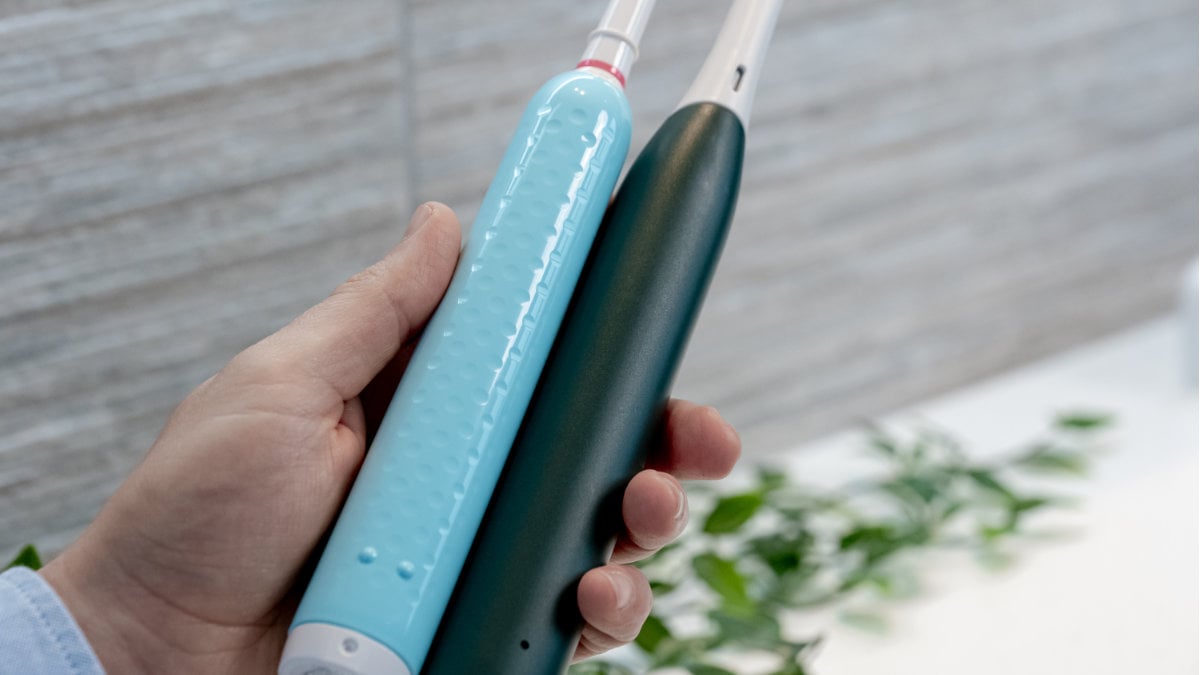
I can’t say it has any significant bearing on how it feels in the hand, but weirdly, compared to the Pro 1 I think the iO2 feels less slippery in the palm when wet. This is even once I have taken into account the dimpled texture to the rear of the Pro 1’s handle, which is something the iO2 does not have.
There isn’t much between them, but I prefer the iO2’s slightly larger power button. There are two almost complete circles of raised dots that help the button stand out to the fingertip.
I also like how the LED within the iO2’s button is more obvious than the Pro 1’s. Located in the lower third of the handle on the Pro 1, it is easier to miss a low battery warning because the LED is smaller and not quite in the eyeline like the iO2’s.
There are marginal size and weight differences between the 2 handles as shown in the following table:
| Toothbrush height with head |
| Width |
| Depth/thickness |
| Weight with head |
|
Oral-B Pro 1
|
Oral-B iO Series 2 (iO2) + travel case
|
|---|---|
| 23.2cm / 9.1 inches | 24cm / 9.5 inches |
| 2.5cm / 1 inches | 2.8cm / 1.1 inches |
| 2.9cm / 1.1 inches | 2.8cm / 1.1 inches |
| 123g / 4.3oz | 124g / 4.4oz |
The iO2 is available in 4 colours: black, white, pink and green. There are 3 choices with the Pro 1, black, pink and blue.
Same brand, different brush heads
The keen eyed may notice how the 2 brushes have similar but different brush heads.
Although both use a push on and pull off style attachment, the heads suitable for the iO2 are specific to the iO Series and not compatible with the Pro 1.
The heads for the Pro 1 are not suitable for the iO2 either.
There is a significant and arguably unjustifiable price difference, which I comment on in a later section of this comparison.
Oral-B’s round brush head design has been continued with the iO Series, but they are marginally bigger at the back of the head. I’d suggest they are about 10% larger in surface area. It’s not a huge difference, but if you have a small, cramped mouth and are used to the Oral-B heads like those used by the Pro 1 you will notice a difference.

It hasn’t hampered my brushing experience much, but I can feel a difference between them.
One positive is that the range of brush head choices for the iO Series is smaller. It makes it easier to pick between them. My recommended choices are the Gentle Care or Ultimate Clean head. As the name implies, the Gentle Care head has the softer bristles and feels more comfortable if my gums are tender for any reason.
The iO2 typically comes supplied with 1 x Gentle Care head. The Pro 1 on the other hand comes with a single, firmer bristled CrossAction head, in most instances.
The Pro 1 on the other hand comes with a single, firmer bristled CrossAction head, in most instances.
Something I have picked up from the extended use of both models is that the heads for the Pro 1 are easier to keep clean.

Holes in both the Pro and iO Series brush heads allow for moisture to escape, but they also allow for moisture to get in. As this video shows, there is a tendency for the iO head to accumulate mold. I only became aware of this as a result of the more stagnant taste as I brushed.
This is something that doesn’t seem to pose an issue on most other electric toothbrushes, as it’s only Oral-B that has holes in the head itself.
Needless to say it is something that is accounted for in the overall scores given in my full Oral-B iO Series 2 review. I must stress that I don’t think it is a reason to avoid the iO2, but it is something to be aware of.
The iO2’s pressure sensor is technically better, but it yields little benefit
If you apply too much force when brushing, the motor in both brushes will automatically slow the bristle movements, limiting the chance of damage being inflicted on the teeth and gums.
It is nigh on impossible to tell if the sensor has been activated on the iO2 or the Pro 1. Neither produce an audible beep or vibrate the handle differently. If there is a sound change, my ears don’t detect it.
Technically, the iO2 is one step ahead of the Pro 1 though. That is because the LED within the power button illuminates red when the sensor is activated. Oral-B makes quite a big deal of this in its marketing materials.
Unfortunately, though, it is virtually impossible to see. Only when I maneuvered the handle into less common positions did I catch a glimpse of it, primarily via the mirror that I was brushing in front of.
It is a step in the right direction, but it’s not the clear vibration signal I’d get from Sonicare handles. Nor is it the clear LED notification included with the likes of the Pro 3 3000 or the other brushes in the iO range.

My preferred cleaning modes are included with both brushes
Both the iO2 and the Pro 1 offer 3 cleaning modes. Daily Clean and Sensitive are available on both handles. These are my preferred choices when it comes to Oral-B's cleaning modes.
The third mode is a whitening on the Pro 1 and super sensitive on the iO2.
Of the two, I prefer super sensitive. I feel it suits new electric toothbrush users and those with very sensitive teeth and gums best.
The whitening mode is the one our readers ask about the most. The name implies that it has a stronger effect than it really does. I’ve found that it’s no different to other modes when it comes to lifting stains from the teeth. If used correctly, an electric toothbrush will at best remove light staining, it won’t ‘whiten’ your teeth.
Neither model has any cleaning mode icons or labels to show which mode is active. This can be infuriating. The iO2’s power button LED flashes a different number of times based on the mode chosen, but this still doesn’t make it particularly easy to tell at a glance.
Thankfully a slight redemption for the iO2 is that you can change the default cleaning mode to any of the 3 available. This isn’t an option with the Pro 1, which always starts in Daily Clean mode.
I mentioned in the ‘Does one clean better than the other’ section above that the brush motors are different. A noteworthy benefit of this is the noise the iO2 produces compared to the Pro 1 is a little less mechanical sounding. It’s less harsh on the ears, despite measuring just 1 decibel quieter in my testing.
The iO2 has far better battery life
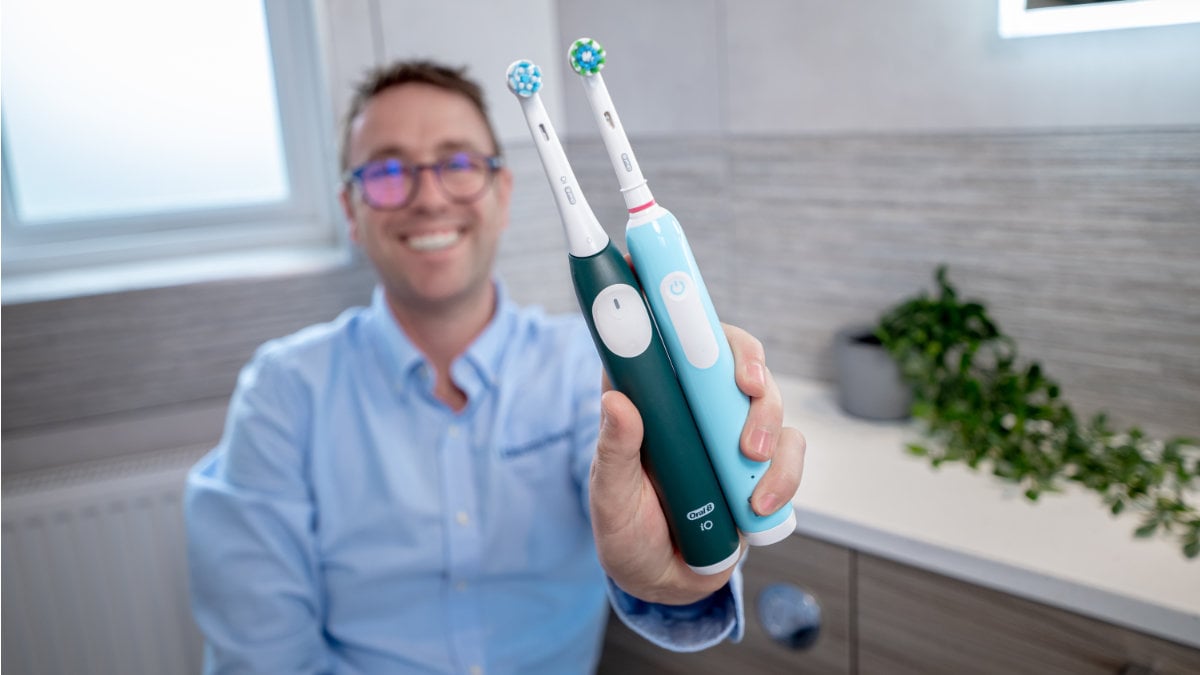
The rechargeable Lithium-Ion (Li-Ion) battery sealed inside the iO2 gave me up to 37 days use on a full charge compared to the 10 days from the Nickel Metal Hydride (NiMH) battery inside the Pro 1.
The iO2 has the best usage time of any Oral-B brush I’ve reviewed.
I don’t travel frequently, so I don’t typically need extra battery life, but I think 2 weeks of use is a good minimum that a toothbrush should achieve. The vast majority now last for 4 or more weeks.
Both brushes give feedback on the charge status via the LED in the brush handle and both use the same charging stand.
The Pro 1 takes up to 12 hours to charge compared to 24 of the iO2.
Based on their performance, the iO2 does score better overall in our ‘battery performance’ category with a total of 67 compared to the 43 of the Pro 1.
Conclusion
The Pro 1 is the more sensible purchase of these 2 models.
The small perks the iO2 offers don’t, for me, outweigh the unjustifiable premium for each of the replacement brush heads. Particularly when cleaning results are no worse with the Pro 1.
If there were to be more parity between the costs of the brush head, my feelings might be different. Until we enter a time where this is the case, I will take the cost savings and put it to good use.