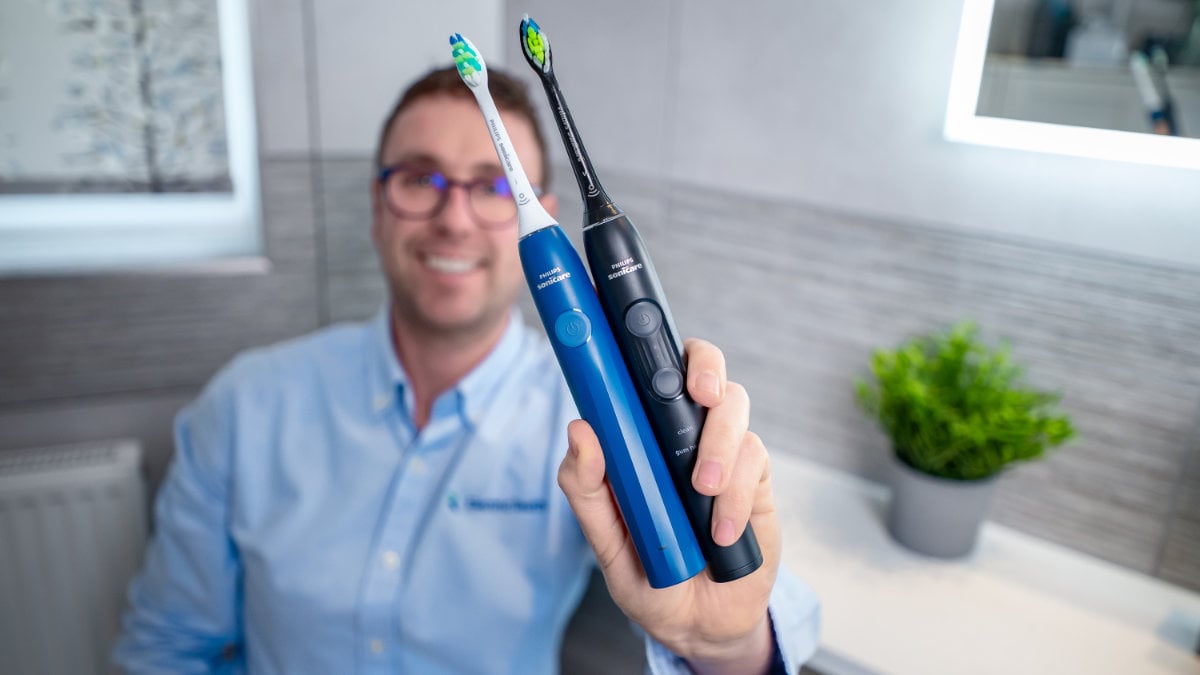




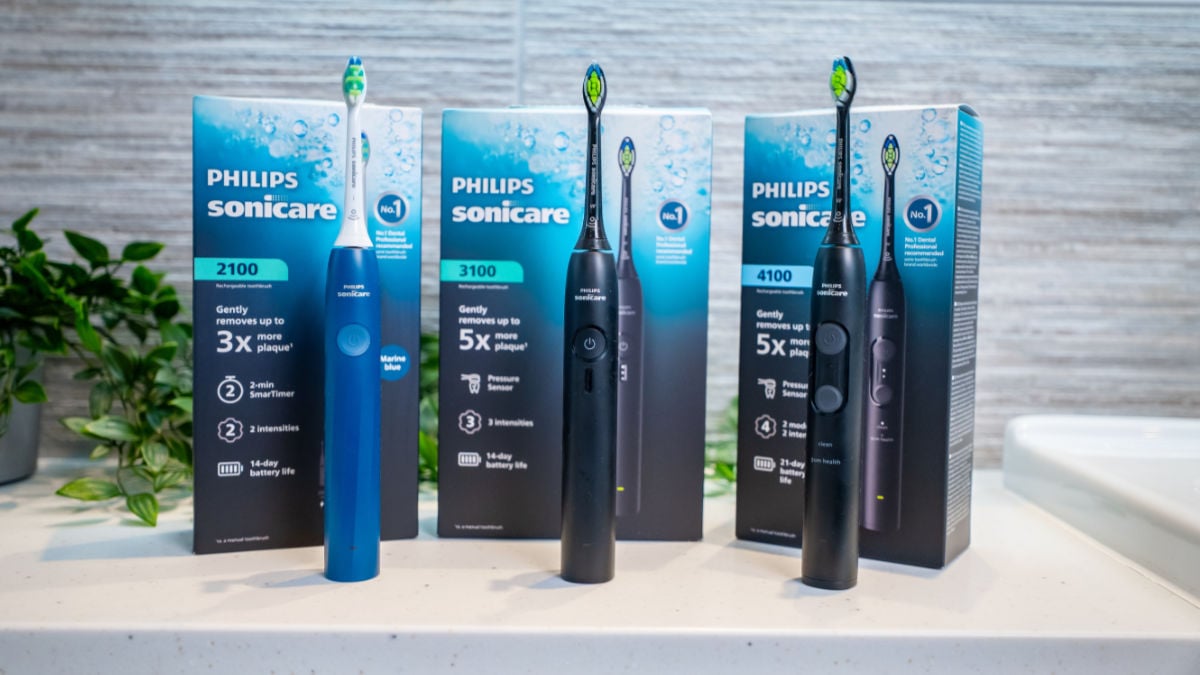
Our choice: Sonicare 4100 Series
It’s one of those brushes I recommend you just buy. It ticks all the boxes required to make it an outright recommendation.
Great cleaning results, a timer, a pacer, and a pressure sensor. Multiple cleaning modes, a good battery life, a practical design, and a sensible price point.
Spending more will buy features you don’t need, and it won’t result in significantly better plaque removal.


When to choose the 2100
If you are on a slightly tighter budget, the 2100 is a great choice that I’d still happily use on a daily basis.
My main complaint is a lack of a pressure sensor. But, this isn’t an issue if you know you don’t scrub your teeth with lots of force.
Battery life is still decent, and in fact, the handle is a little more grippy than more smoothly finished premium models.


Updated 2026 range
The review and comparison on this page is for the updated models that Sonicare launched in 2026. These models are a refresh of brushes that were launched in 2024. We have compared the 2024 range here.
Please note that the listings on some retailers such as Amazon include both the 2024 and 2026 variants. The 2026 variants are denoted with “[new]” or “[new generation]” in their titles.
Another possible point of confusion is the naming system. As an example, the 3100 is a brush that sits within the 3000 Series and the two names are used interchangeably.
There are sometimes slight variations on the brushes available within a Series and they therefore have different model numbers. For example within the 5000 Series there is the 5300 and the 5500.
How we rated them
In the table below you can see how we have scored these brushes in individual categories.
The 4100 and 3100 score very highly because they offer the key features we recommend in an electric toothbrush: a timer, a pacer and a pressure sensor. And they do so at a very reasonable price and with a great user experience.
The main improvements would be a travel case (some variants do include one, but our scoring below is for the versions that do not) and better battery life.
The 2100 and 1100 don't score quite as well because they lack a pressure sensor. You can get by without one, but it is one of the features we recommend paying for.
There are some other differences between them all, which I cover in more detail below.
| Overall Score |
| How well it cleans |
| How it feels |
| Recommended features |
| Additional items & features |
| Battery performance |
| Smart features |
| Price |
| Electric Teeth Rating |
| Buying options |
|
|
|
|
|
|---|---|---|---|
|
87
|
87
|
69
|
69
|
|
100
|
100
|
75
|
69
|
|
88
|
88
|
88
|
88
|
|
82
|
82
|
45
|
45
|
|
62
|
62
|
42
|
62
|
|
87
|
87
|
87
|
80
|
|
0
|
0
|
0
|
0
|
|
87
|
87
|
87
|
87
|

(5)
|
(5)
|

(4.2)
|
(4.2)
|
Detailed review and comparison
These four electric toothbrushes are fundamentally quite similar despite being different models.
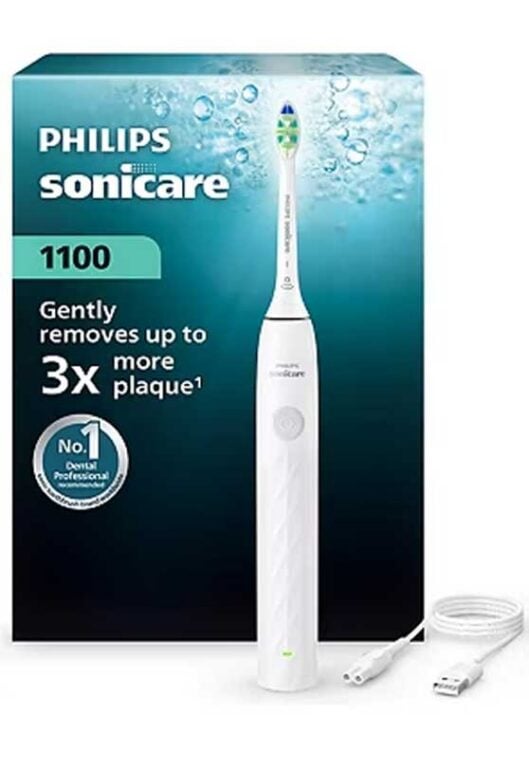
The 4100 is the most feature-rich of the four and is my top choice, but the 1100 isn’t a bad toothbrush, despite having fewer features.
Importantly, they all cleaned my teeth well during testing.
All 4 models have:
- Built-in 2 minute timer
- Built-in 30 second pacer
- Automatic power off
- Battery status LED
- Push-on and pull off brush heads
- Water resistant handle
- User-replaceable battery
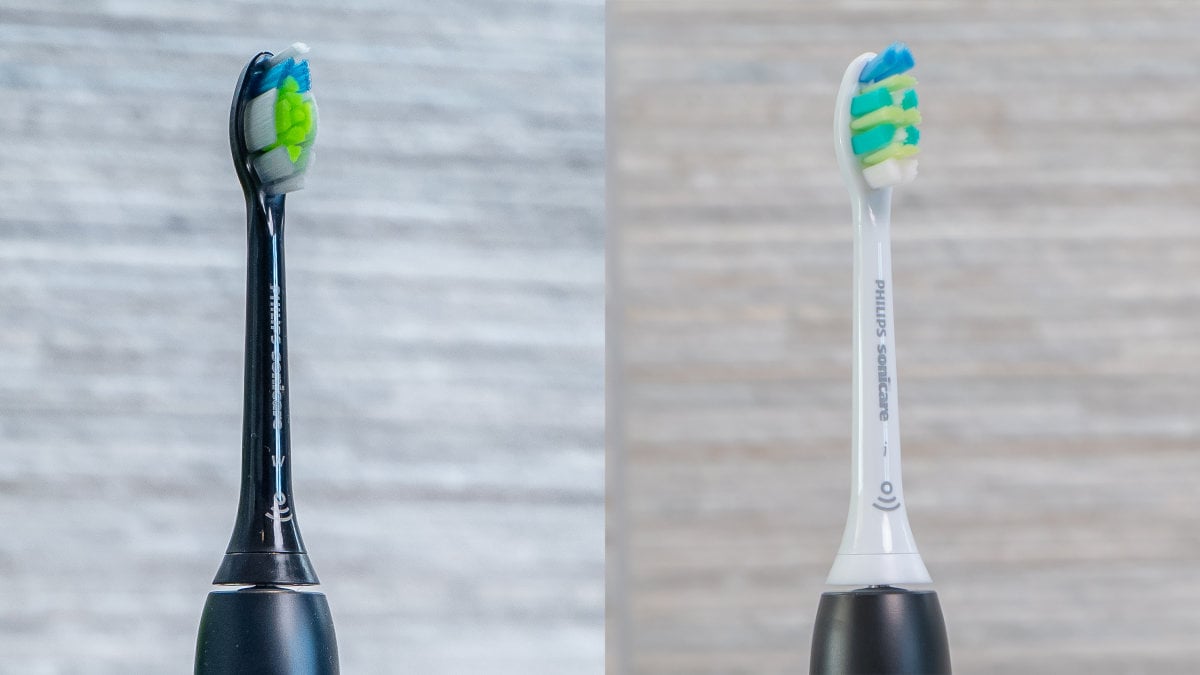
Whilst there are subtle differences in the handle design, size, weight and noise, none of them make a significant difference to the user experience.
The 1100, 2100 and 3100 only have one cleaning mode whereas the 4100 has two.
Only the 3100 and 4100 have a pressure sensor.
Features comparison
Before I go into more detail about how these brushes differ, here's a table to compare their features and prices side by side.
| Retail price |
| Approximate 3 year cost |
| Cleaning Action |
| Number of cleaning modes |
| Brushing intensities |
| Timer |
| Pacer |
| Pressure Sensor |
| Battery life |
| Battery type |
| Number of heads included |
| Travel case included |
| Noise |
| Warranty |
| Buying options |
|
Our Choice
|
|
|
|
|---|---|---|---|
| £90 | £80 | £60 | £50 |
| £100 | £95 | £85 | £80 |
| Sonic | Sonic | Sonic | Sonic |
| 2 | 1 | 1 | 1 |
| 2 | 3 | 2 | - |

|
|
|
|
| 30 second quadpacer | 30 second quadpacer | 30 second quadpacer | 30 second quadpacer |
|
|
|
- | - |
| 21 days | 14 days | 14 days | 14 days |
| Rechargeable Lithium-Ion (Li-Ion) | Rechargeable Lithium-Ion (Li-Ion) | Rechargeable Lithium-Ion (Li-Ion) | Rechargeable Lithium-Ion (Li-Ion) |
| 1 | 1 | 1 | 1 |
| - | - | - | - |
| 63dB | 56dB | 57dB | 57dB |
| 2 years | 2 years | 2 years | 2 years |
The 3100 and 4100 offer the best clean
I can’t say that any of these brushes give a bad clean of the teeth.
Used correctly, all do a good job of removing plaque on the tooth surface and at the gumline.
I’ve used all 4 and my at-home plaque disclosing test results speak for themselves.
The results are slightly better from the 3100 and 4100. This is a consequence of the more powerful motor in these 2 models.
The cleaning sensation is slightly more intense and invigorating than the 1100 and 2100 Series. I personally like this, but it won’t be to everyone’s preference.
Make no mistake, I would happily use the 1100 and 2100 Series, but I just don’t come away with quite such a long lasting deep clean feeling.
All models offer 31,000 strokes per minute, but the motors are tuned differently to alter the sensation. Essentially, the motor's amplitude is configured differently, although Philips hasn’t explained — and likely won’t explain — exactly how.
Compared to higher end models, there is a small but noticeable difference. With these models, you are not getting the absolute best motor setup, but it’s not something that I feel you need to worry about. I certainly don’t. Your technique and brushing time have a much greater impact.
Further impacting our scores for how well each brush cleans are the modes and intensity settings each brush offers. Where there's just 1 mode on the 1100, the 4100 offers 4 different brushing configurations, giving more granular control of the intensity. It’s not strictly necessary, but it gives you more choice. This can be useful if you have sensitivity, for example.
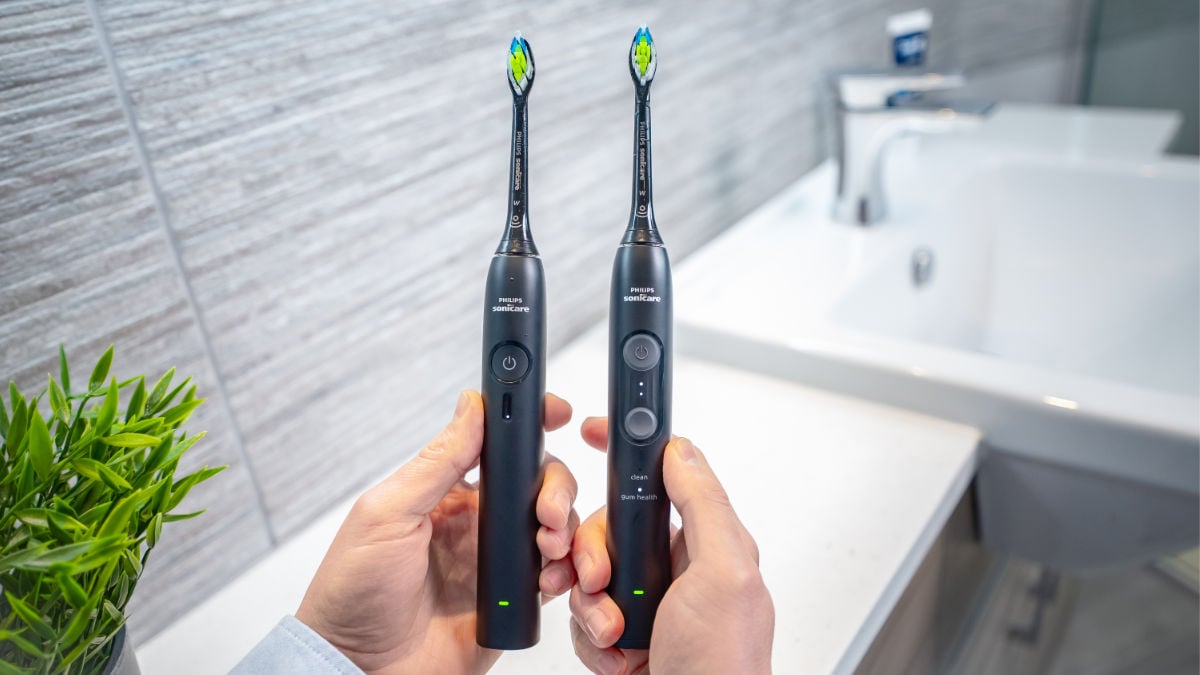
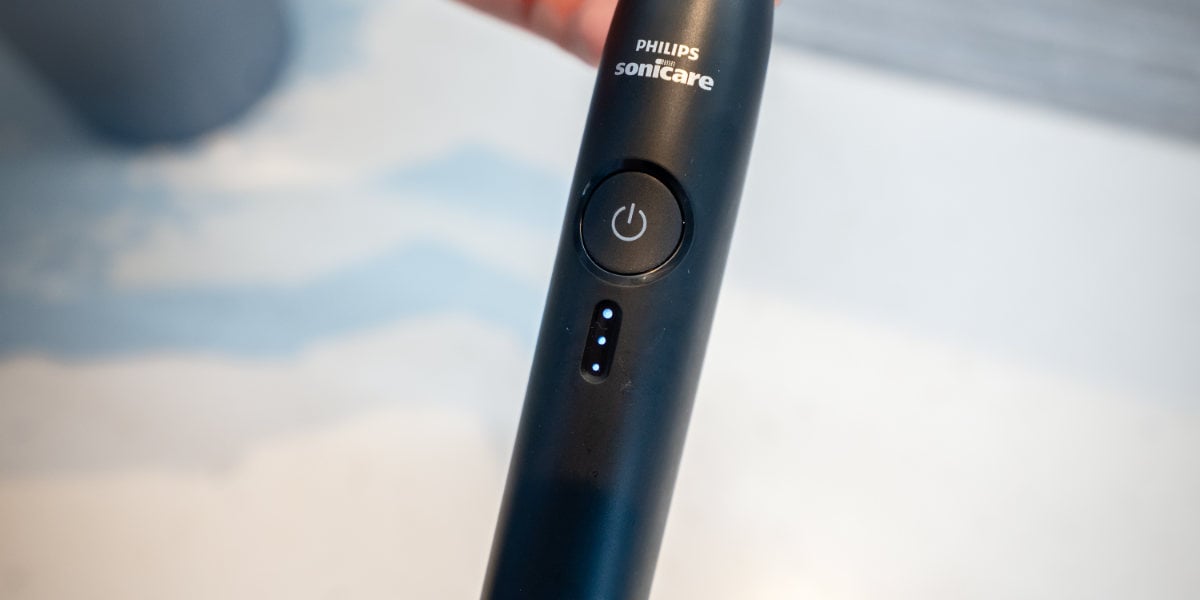
One thing Sonicare does well in comparison to the competition is signalling what mode or intensity is selected. They do this by using LEDs and mode name labels on the handle.
The 2100 is somewhat an exception to this rule. It only has 2 intensities, but no LED or mode label to show which is which. It relies on you being able to detect the difference between the brushing sensation and sound. It’s a little inconvenient, but it’s fairly easy to distinguish between them, particularly after a few uses, as there is a noticeable difference. Any more than two intensities and it would get quite tricky as the differences are more subtle.
As a general rule, I don’t think you need anything more than 2 cleaning modes / intensities. A standard mode and then a gentler mode do the job for most users. There is a lack of meaningful evidence to show extra modes or intensities have much benefit.
The 3100 has 3 intensities and shows which is selected using LEDs. The 4100 has 2 mode labels and 2 intensity LEDs.
Different brush heads included in the box
The 1100 and 2100 come supplied with an I Intercare brush head, whereas the 3100 and 4100 come with an Optimal White brush head. This isn’t something to pay much attention to during your buying decision because the heads are interchangeable — you can switch to a different one when you buy a new pack of heads.
So, if the 1100 comes with an Intercare head but you want to use a premium A3 all-in-one head on it, you most certainly can.
See our post on the best Sonicare brush heads for a more detailed explanation.
Do note that none of these models support Philips BrushSync technology, which can remind you when a brush head needs replacing. None of the handles have the technology. The previous generation did. You’re not missing out on much here; it’s a nice-to-have feature but far from essential.
Grippier handles on the 1100 and 2100 Series
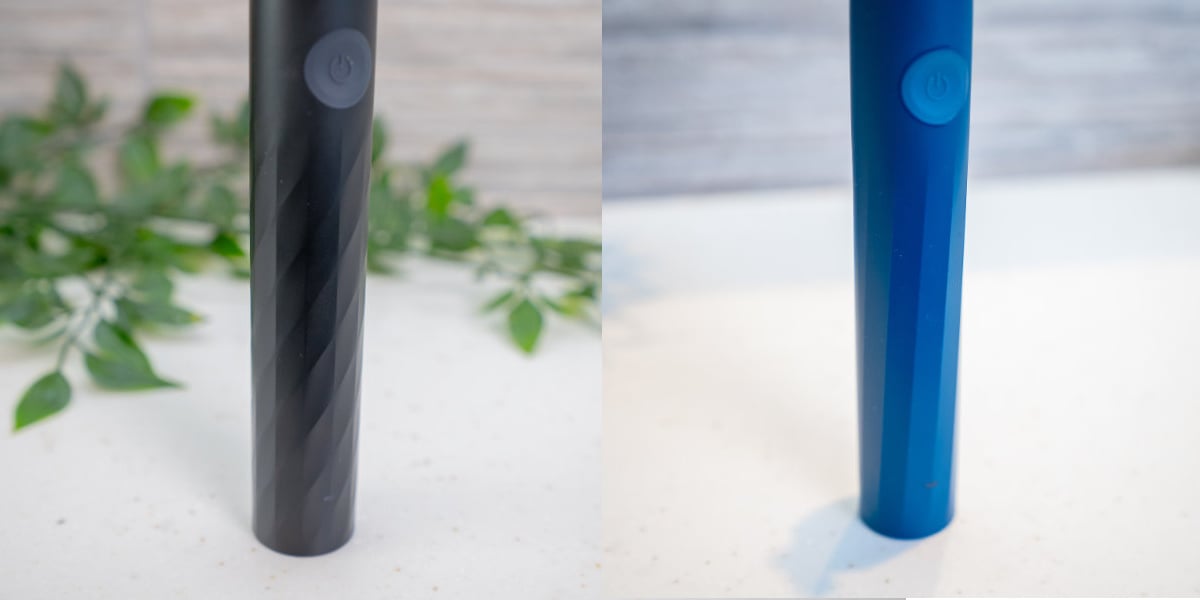
A positive difference between the 1100 and 2100 Series is the texture of the handles.
Where the 3000 and 4000 — and all premium Sonicare handles — have a matte finish and are smooth to the touch, there is noticeable added texture built into the handle moulding for the 1100 and 2100.
The 2100 has a series of ridges that run diagonally around the handle. They are not vertical like many textured handles, nor are they horizontal.
The 1100 has a similar design, but the ridges run in two directions and intersect, creating a criss cross, squared texture that is more grippy.
Sonicare models don’t tend to feel slippery in the hand like the gloss handles of many Oral-B brushes, but I do welcome this design touch. It’s helpful for both smaller, younger hands, and those with dexterity issues. Given that these handles have a slimmer footprint than a lot of toothbrushes, it certainly helps.
Because it is plastic rather than a rubber/silicone found on Oral-B’s Vitality range, it isn’t as soft or reassuring a grip in the hand. The benefit is that it is much easier to clean than the dimpled grip on the Vitality, which seems to easily attract toothpaste residue.
All of them apart from the 1100 come with a USB charging stand
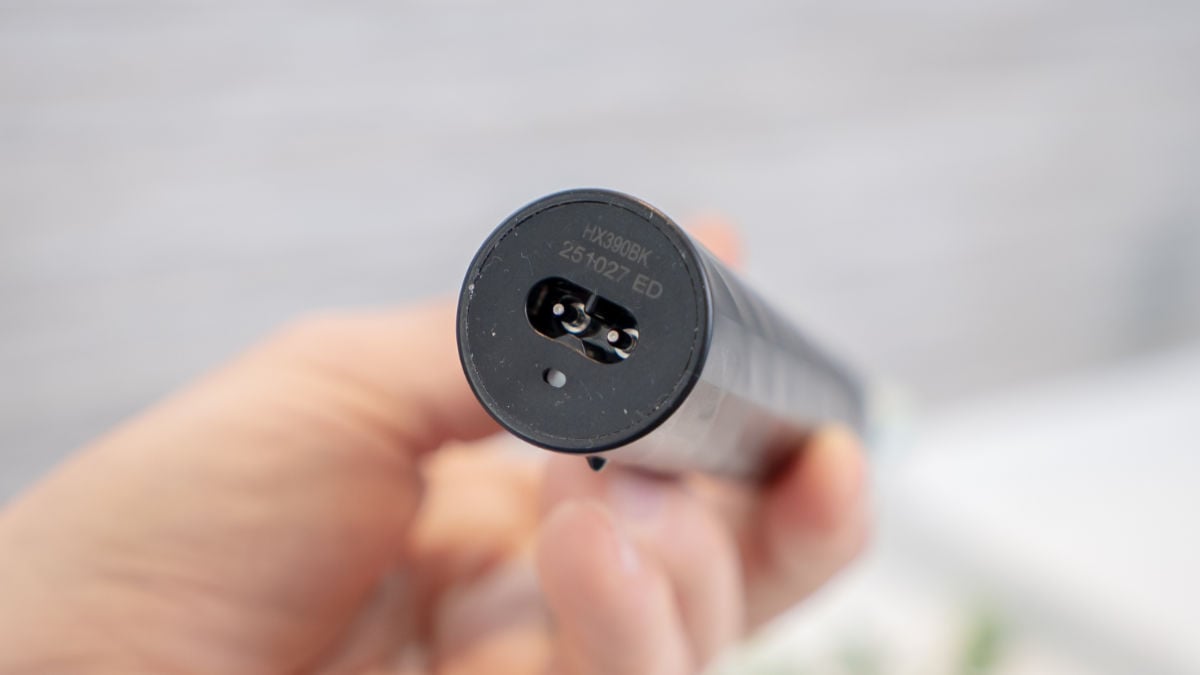
Unlike the vast majority of electric toothbrushes, the 1100’s battery isn’t replenished by sitting the handle on the conventional charging stand.
Instead, it is a case of connecting a USB cable to the base of the brush handle.
Brushes from some other brands are configured this way, but this is a first for Philips as far as I am aware, except with its super slim and travel-friendly Philips One by Sonicare toothbrush.
To charge it, you need to lay it down somewhere with access to a USB socket. For many people this will rule out charging it in the bathroom unless they have USB sockets fitted.
There is a full-sized USB connector at one end of the cable and a proprietary Philips connector at the other.
Given this brush has been launched in 2026, a USB Type-C connector would be far more sensible and appealing. If you travel with this brush, you have to carry a separate cable. Should you lose it, it’s not one you can just pick up off the shelf at the local electronics store.
There is an argument that the proprietary connection is more durable and in the past I would have been more onboard with this, but now I do favour the practicality of a USB-C cable, which is still very durable.
USB Type C adapters exist, as demonstrated in this video on our YouTube channel, but that’s a separate, unofficial accessory.
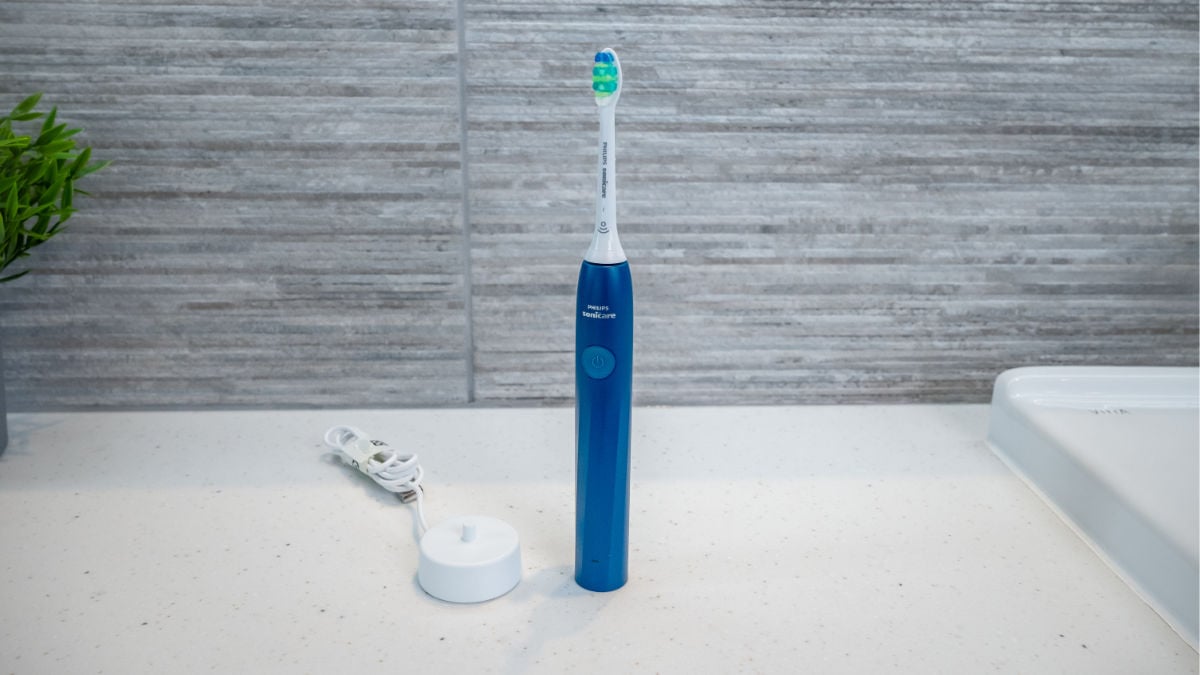
The other models use USB charging stands. In an effort to reduce e-waste, none come with 2 pin power adapters as many people will already have one on hand.
All the handles have rechargeable Lithium-Ion batteries built-in. It is the more premium 3100 and 4100 that are claimed by Sonicare to last 21 days rather than the lesser 14 days of the 1100 and 2100 Series.
My hands-on testing demonstrated that all far exceeded their claimed usage time, which is fantastic. Less frequent charging is always a positive.
Sonicare states a full charge can take up to 24 hours, which is getting on for twice as long as many Oral-B iO models, for example, but I’ve found they are typically replenished more quickly.
As a consequence of the above, the 1100 doesn’t score quite so highly in our battery performance category.
The 3100 and 4100 Series have a pressure sensor
Harder and faster brushing isn’t the key to good brushing. In fact, it's potentially damaging to the teeth and gums.
The 1100 and 2100 won’t warn you if you are applying too much force, but the 3100 and 4100 will.
When activated, the pressure sensor will slow the movements in the brush head and create a very different vibration pattern through the handle.
Such a change creates an audible difference too, meaning at least one out of the two alerts works for blind and deaf users.
Oral-B has better visual sensors in many of their handles, but they are just that — visual only — which in my opinion makes the Sonicare configuration stronger.
If you want a light ring to catch your attention as a pressure sensor alert you will need to consider more premium models like the 6100, 6500, and above.
The key is to not apply too much force to begin with; you should let the bristles skim the tooth surfaces, albeit you want to apply a light amount of force. But, if you know you have a tendency to brush forcefully, consider the 3100 or 4100.
If you’ve never had an electric toothbrush and you’re not sure if you brush forcefully, a pressure sensor is a feature worth paying for, at least to begin with. Similarly, if you have sensitivity, it could be due to using too much force, so go for a pressure sensor.
If you want a travel case, pick the 3100 or 4100
Whether you’re going for 1, 2 or 14 nights away, it can be very helpful to have a travel case to protect the handle and the brush head.
The more affordable 1100 and 2100 don’t come with one, but some versions of the 3100 and 4100 do.
The cases are basic but functional. They reduce the risk of unwanted damage and prevent wet bristles from coming into contact with stuff they shouldn’t. The case will hold the handle and up to 2 heads.
I think a case is worth up to £10 more, but often it isn’t necessary to spend extra money to get one. Often the bundle with a case is cheaper than buying the brush on its own. Why, I don’t know — it’s just part of the pricing strategy.
Prices vary, but even the premium model doesn’t break the bank
The 4100 Series is the most expensive in the range with a retail price of £90.
Don’t pay the retail price if you can help it. As a general rule, all of these models will sell in the region of 20-50% off list price.
All models are good value for money and come with at least 1 brush head in the box.
Sonicare heads are a touch pricier than the Oral-B heads, but there’s not a huge amount of difference between them.
Over 3 years, the 1100 will cost in the region of £80 to own, whereas the 4100 will cost £100 or more. The 4100 Series is about £15 cheaper to own than the iO3 from Oral-B.
There might be better prices at certain times of year, but don’t hang out for these. It’s better to just buy it, use it, and gain the benefits sooner.
All models are good value compared to more highly featured models. Given there is no meaningful difference in cleaning results, it really isn't that important to spend more.
Eco credentials have improved, but there’s more work to be done
A 2-year warranty is provided as standard. This is the typical warranty for consumer electronics so it nothing more than satisfactory in that regard.
Thankfully, it's possible to replace the internal battery on these brushes should it wear out, which is a move in the right direction. Philips doesn’t promote this heavily, but it is possible to do at home without the need for specialist tools or experience.
Given that the battery is a common part to wear out or fail over time, this is a nice touch. Our video here shows you how to do it. Do note the 1100 has wires soldered to the base, so it is still possible, just a little trickier. And at this time, Philips doesn’t sell the battery itself — it’s necessary to seek out specialist providers.
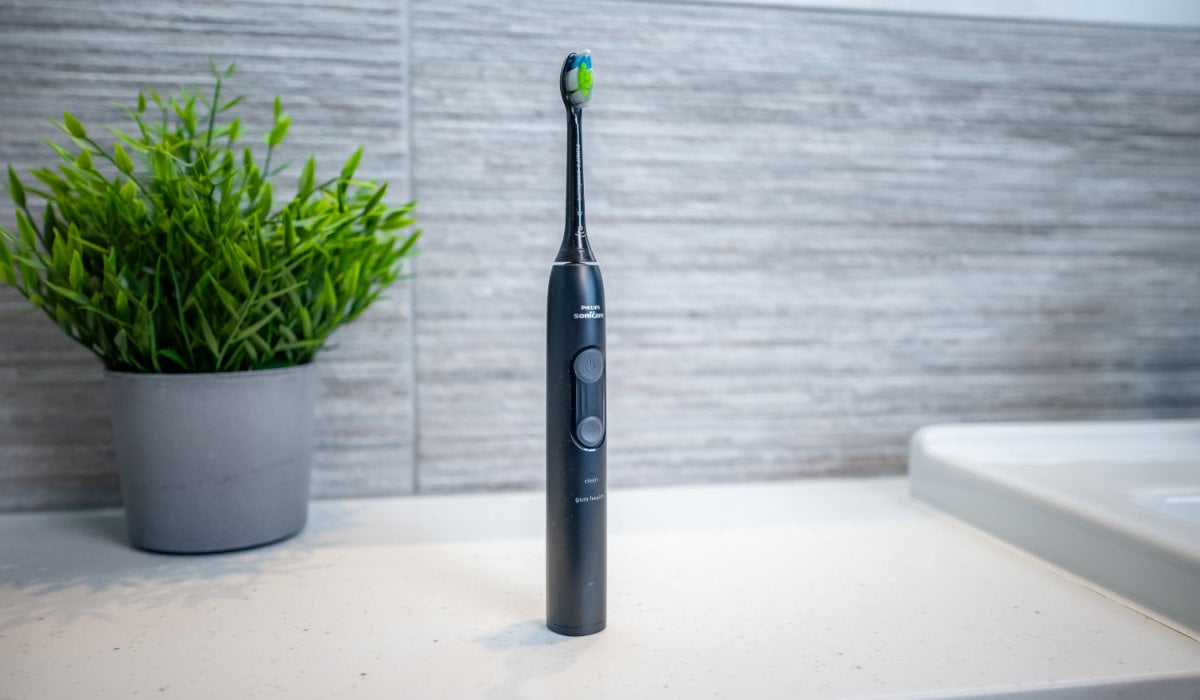
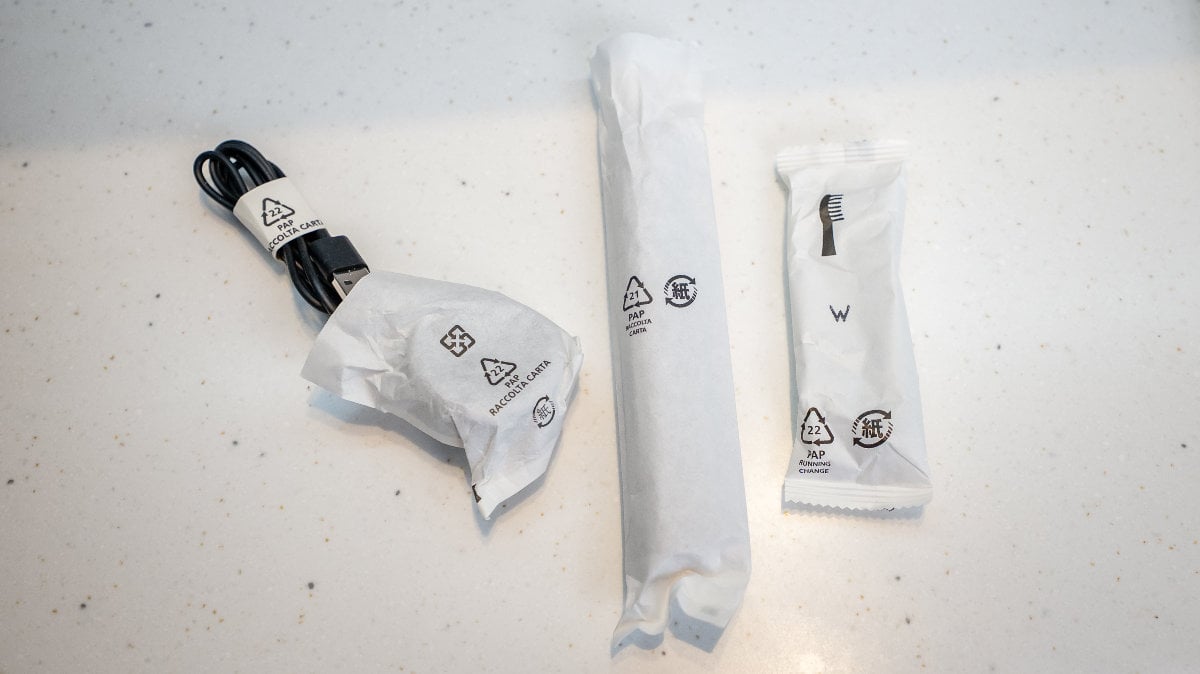
Sonicare uses paper packaging as standard now and there doesn’t tend to be an overly large, chunky manual anymore. At least all the packaging is recyclable, unlike the plastic many brushes now come wrapped in.
Brush heads are now made from bio-based plastic, which is a big step forward for Philips. That being said, most of them now contain RFID chips.
Something that is still lacking is a robust return/recycling scheme for used heads or even aged handles. This is the next big step to compete with challenger brands like SURI. In the past Sonicare had partnered with TerraCycle for disposing of used brush heads, but that scheme has now been discontinued.
Philips has the might to lead the charge here, but they haven’t. Oral-B is no better for the sake of comparison.
Conclusion
If you want the most affordable Sonicare that delivers a good clean, pick the 2100.
The lack of a pressure sensor isn’t a deal breaker, although it can be useful.
A more intense clean and satisfying result is available from the more expensive, but still fairly priced 4100, which is my main recommendation.
With an additional mode and the choice of 2 brushing intensities, this is a great option for new and experienced electric toothbrush users alike.
All brushes score over 4 out of 5 in our ratings, but it is the premium models that clinch the top spot with a 5/5 rating.