





Our verdict
The quietest electric toothbrush is the Oclean X Pro Elite, producing 48 decibels (dB)* of noise.
The table below compares it to my overall pick for the best electric toothbrush, SURI 2.0. I measured the SURI 2.0 output at 58dB. This makes it around 10dB louder than the X Pro Elite, but it's still a very quiet brush.
As you can see in the table below, we rate both brushes highly. The Oclean X Pro Elite has some smart features, whereas SURI has better environmental credentials and includes a best-in-class travel case.
Unless you need to keep noise to a minimum, I wouldn't regard quietness as the most important factor when choosing an electric toothbrush.
I have included an additional table later in the post that lists various brushes and their noise ratings.
| Overall Score |
| How well it cleans |
| How it feels |
| Recommended features |
| Additional items & features |
| Battery performance |
| Smart features |
| Price |
| Support & reputation |
| Noise |
| Buying options |


How loud are toothbrushes?
The following table lists the noise in decibels (dB) of the most popular models on the market today.
I have not listed every single model I have tested, otherwise it would make for a very long list.
In most instances, very similar models from the same brand are within a few decibels of each other.
The Philips Sonicare ProtectiveClean 4300 is as loud as a Sonicare ProtectiveClean 5100 for example.
I will keep this list as up to date as possible. If a particularly loud or quiet brush should be made available I will include it.
It is not possible to test every toothbrush that exists on the market today. So, yes, theoretically there may well be a quieter or louder brush available that might not be on the list. As a general rule, I am including products that are more widely sold and available to the vast majority of people.
To help give some comparison to everyday life:
- 80dB = Busy street or an alarm clock
- 70dB = Busy traffic or a phone ringtone
- 60dB = Normal conversation at 3ft
- 50dB = Quiet office or quiet street
- 40dB = Quiet residential area or a park
- 30dB = Quiet whisper at 3ft or a library
|
Oclean X Pro Elite
|
|
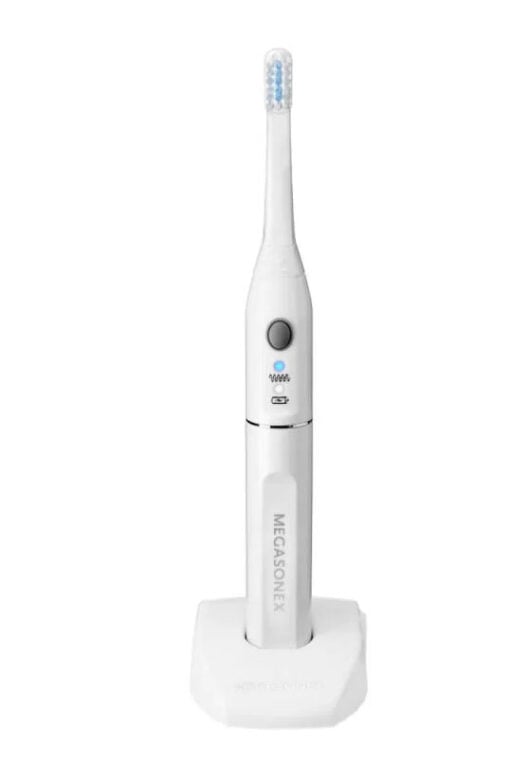
Megasonex M8S
|
|
SURI Core 1.0
|
|
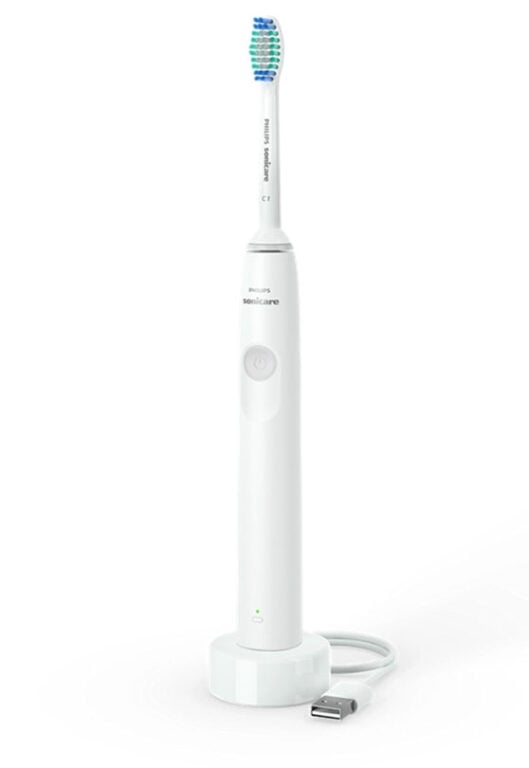
Philips Sonicare 1100 Series
|
|
SURI Pro 2.0
|
|
Ordo Sonic+
|
|
Philips Sonicare 2100 Series
|
|
Philips Sonicare 3100 Series
|
|
Philips Sonicare 4100 Series
|
|
Philips Sonicare ExpertClean 7300
|
|
Philips Sonicare Series 5300
|
|
Oral-B iO Series 3 (iO3)
|
|
Oral-B iO Series 4 (iO4)
|
|
Oral-B iO Series 6 (iO6)
|
|
Philips Sonicare DiamondClean 9900 Prestige
|
|
Oral-B iO Series 9 (iO9)
|
|
Oral-B Vitality
|
| Cleaning Action | Noise | Buying options |
|---|---|---|
| Sonic | 45dB - Came in at approx 48dB in hands on testing | |
| Ultrasonic | 0-51dB | |
| Sonic | 54dB | |
| Sonic | 57dB | |
| Sonic | 58dB | |
| Sonic | 58dB | |
| Sonic | 60dB | |
| Sonic | 60dB | |
| Sonic | 60dB | |
| Sonic | 63dB | |
| Sonic | 63dB | |
| Oscillating-rotating & micro-vibrations | 64dB | |
| Oscillating-rotating & micro-vibrations | 64dB | |
| Oscillating-rotating & micro-vibrations | 64dB | |
| Sonic | 71dB | |
| Oscillating-rotating & micro-vibrations | 72dB | |
| Oscillating-rotating (2D) | 73dB |




Video
In the video below I have included some testing examples to show the sound various toothbrushes make.

How I measure the sound
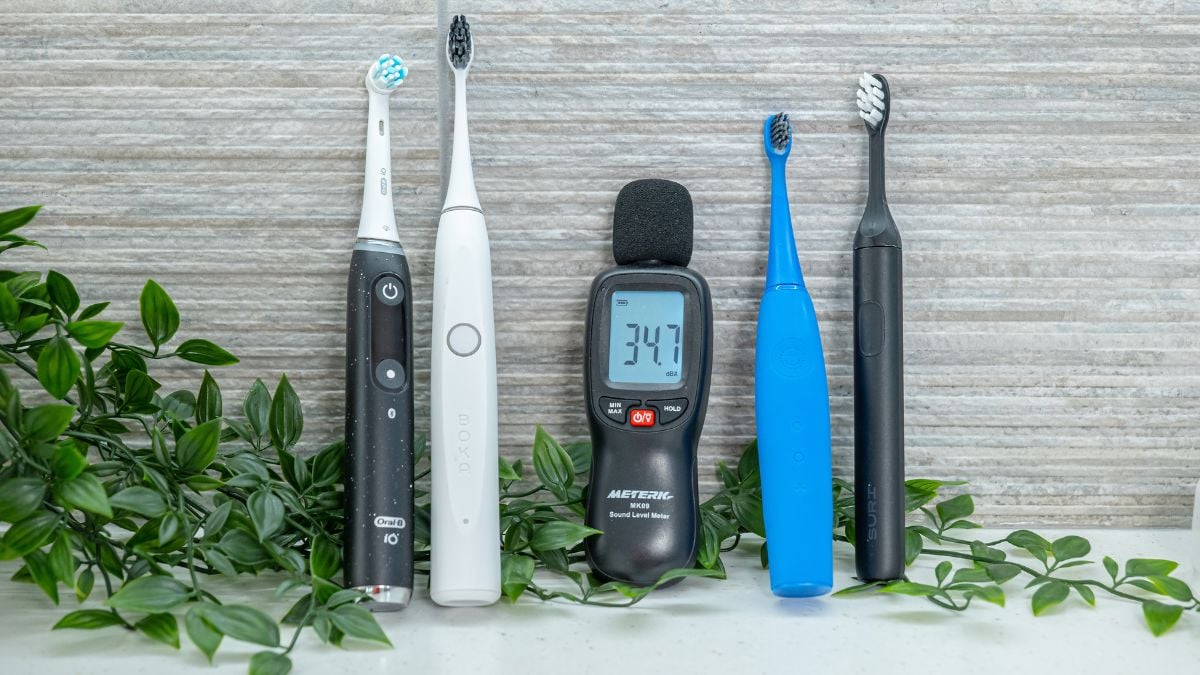
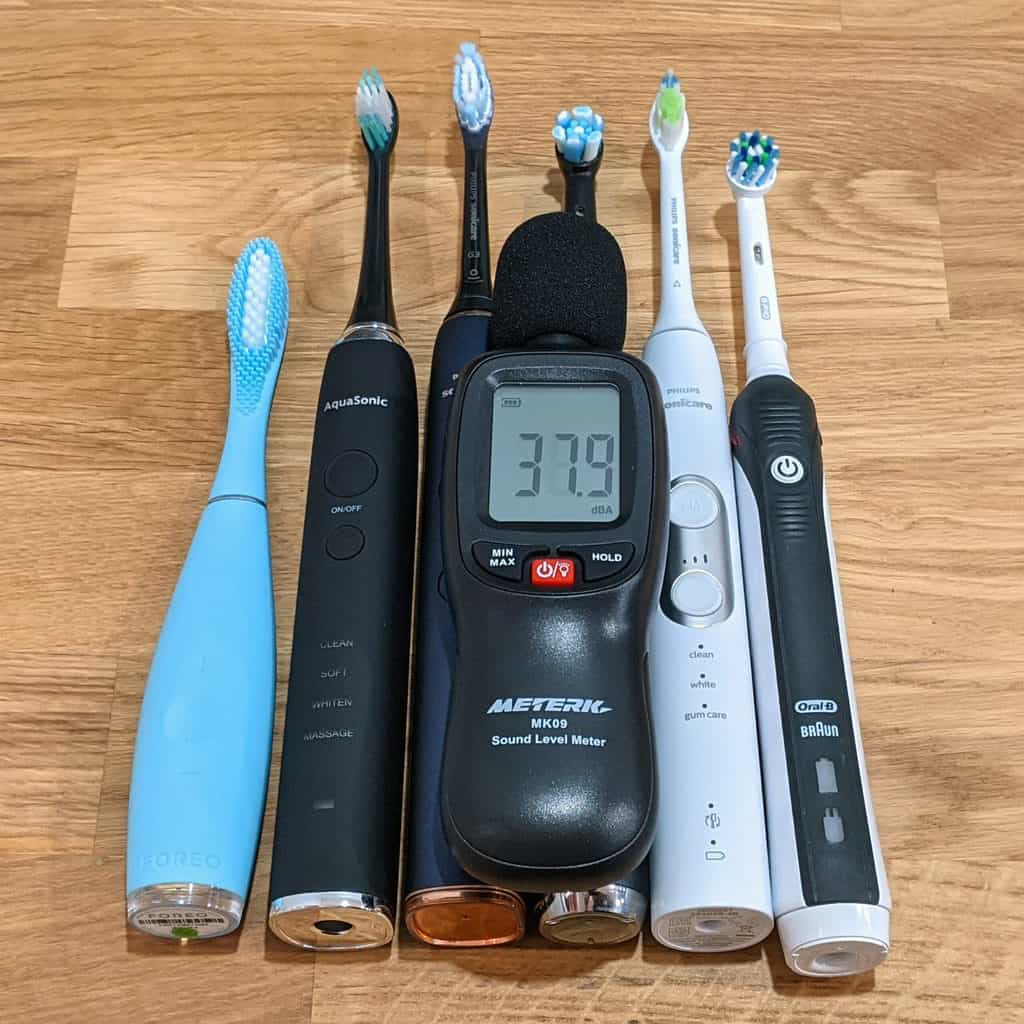
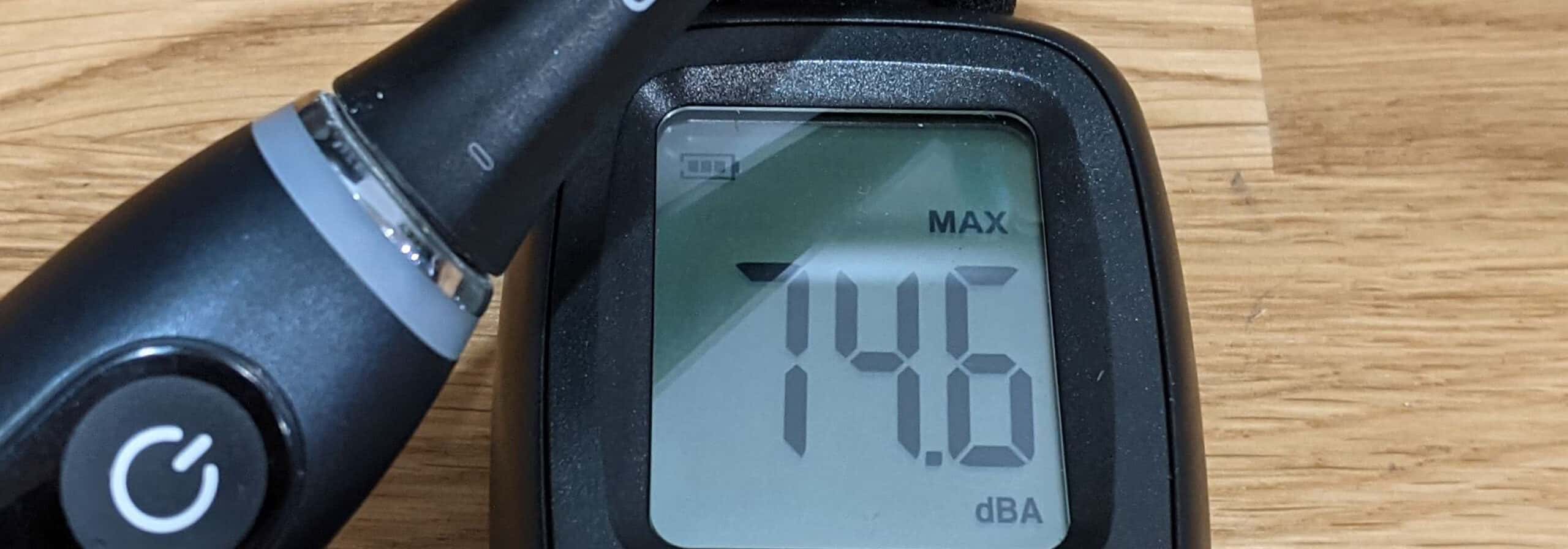
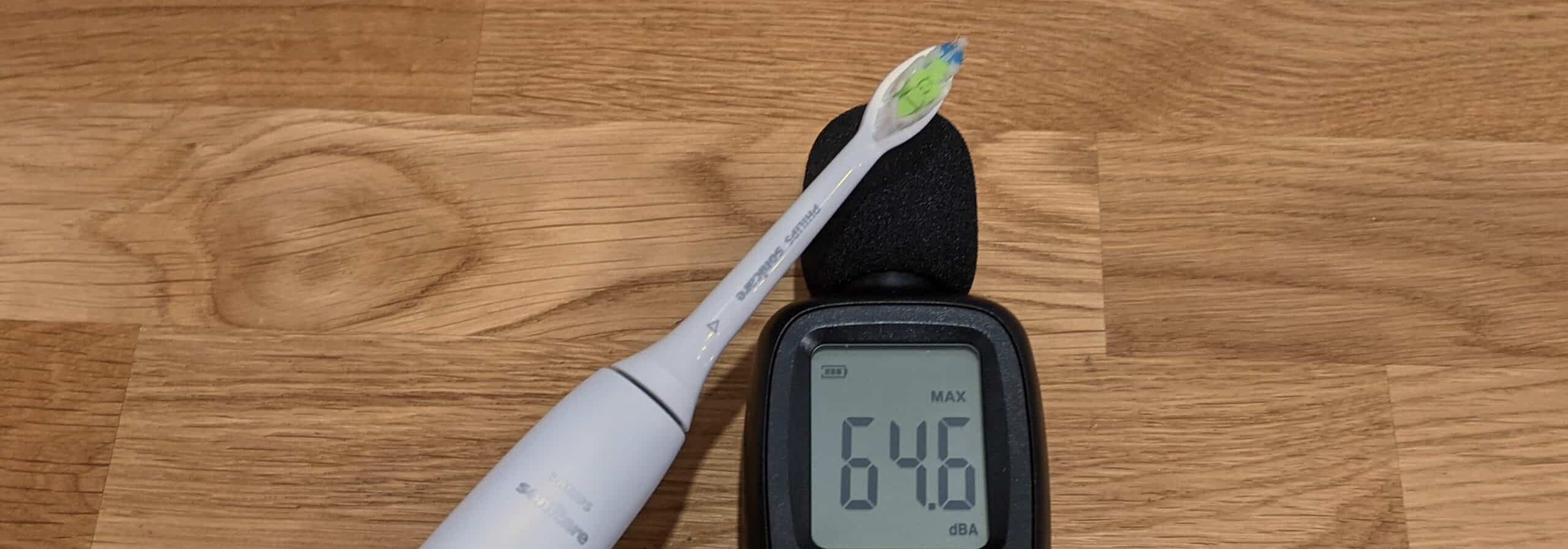
I place the toothbrush 6 inches away from a decibel meter. The toothbrush is held in my hand with a light grip. I turn the toothbrush on and run it through all cleaning modes and intensity settings available.
The decibel meter can measure the minimum and maximum sound. I take the maximum noise it produces as the decibel reading for my list.
It is, therefore, possible that the brush may operate a couple of decibels quieter than I have listed. But this may apply to a specific mode and intensity setting.
For example, if it produces 50 decibels in the standard clean mode, but 53 in the whitening mode, it is the 53 decibels that I record.
The meter will also register any button clicks.
I do not record the sound if the pressure sensor is activated. Some brushes might be louder or produce a different sound if excess pressure is detected. I exclude this to keep things fair.
I try to eliminate exterior factors and keep things consistent, but please note that the readings are to be used as a guide only.
Sonic toothbrushes are quieter
As a general rule, sonic electric toothbrushes, like those produced by Philips Sonicare, tend to be quieter than Oral-B's oscillating-rotating brushes. This is because they vibrate at much higher frequencies.
That being said, there is quite a noise range even between sonic brushes, as shown in the table above.
Oral-B toothbrushes have a much more mechanical sound compared to the softer humming noise that a sonic toothbrush produces.
It can vary from one model to another, but typically the noise difference between these 2 brands is in the region of 10 decibels.
In 2020, Oral-B introduced the iO range which uses a different motor to previous brushes they have released. This new motor and the way in which it moves the brush head has resulted in a quieter toothbrush.
However, the iO is still louder than most sonic toothbrushes, but it is approximately 2-12 decibels quieter than older Oral-B brushes (subject to model).
Paying more doesn't mean a quieter brush
Paying more for an electric toothbrush doesn’t necessarily mean it will be quieter. In fact, some of the quietest options are the cheaper ones.
The power or number of brush head movements has quite a bearing on the noise output.
A sonic electric toothbrush generally produces somewhere in the region of 31,000 brush strokes per minute. That is over 500 brush strokes per second.
An oscillating-rotating electric toothbrush generates anywhere between 7,600-10,000 oscillations per minute. That equates to 127-175 movements per second, subject to model.
In addition, Oral-B electric toothbrushes produce an additional movement known as pulsations which range from 20,000-48,000. That is a further 333 to 800 movements per second, subject to model.
It is this repeated back and forth movement in the head that not only cleans the teeth, but also creates some of the noise. Just how much noise depends on the mechanism used to generate the movements.
In addition to the motor you have other parts such as cogs and gears that all contribute to the operation of a toothbrush and the noise it makes.
I have used and tested well over 100 brushes and for the most part all of those brushes operate within a similar sound range.
Only on a couple of occasions has a product stood out for being particularly quiet.
I can’t say one model has stood out for being particularly loud, but rather the ‘loud’ categorisation applies to Oral-B as a whole. This is certainly a generalized statement, but I feel it highlights the difference appropriately.
Imagine you are brushing your teeth in the bathroom next to a bedroom in which someone is sleeping. With a sonic toothbrush, you could likely leave the doors open and not wake that person in the room next door. With an Oral-B brush you would likely want to shut the door so as not to wake them up.
Muting/deadening the sound
It is possible to reduce the sound of a toothbrush.
The most common suggestion given is to wrap your toothbrush in something. Preferably something soft, yet thick.
This wrapping around the toothbrush is designed to deaden the sound. A towel, wash cloths or t-shirt are examples of what you could use.
This is often a cheap and convenient way to suppress some of the noise.
The reality is that none of these work very well. I actually found it to be more hassle than it is worth. But, in certain situations, it may well be better than nothing.
In my own testing, I took an Oral-B Pro 2 2500 that produces 76 decibels and wrapped it as best as I could with a towel. The sound it produced dropped by just 5 decibels to 71.
With a Sonicare ProtectiveClean 6100 it dropped from 62 to 59 decibels.
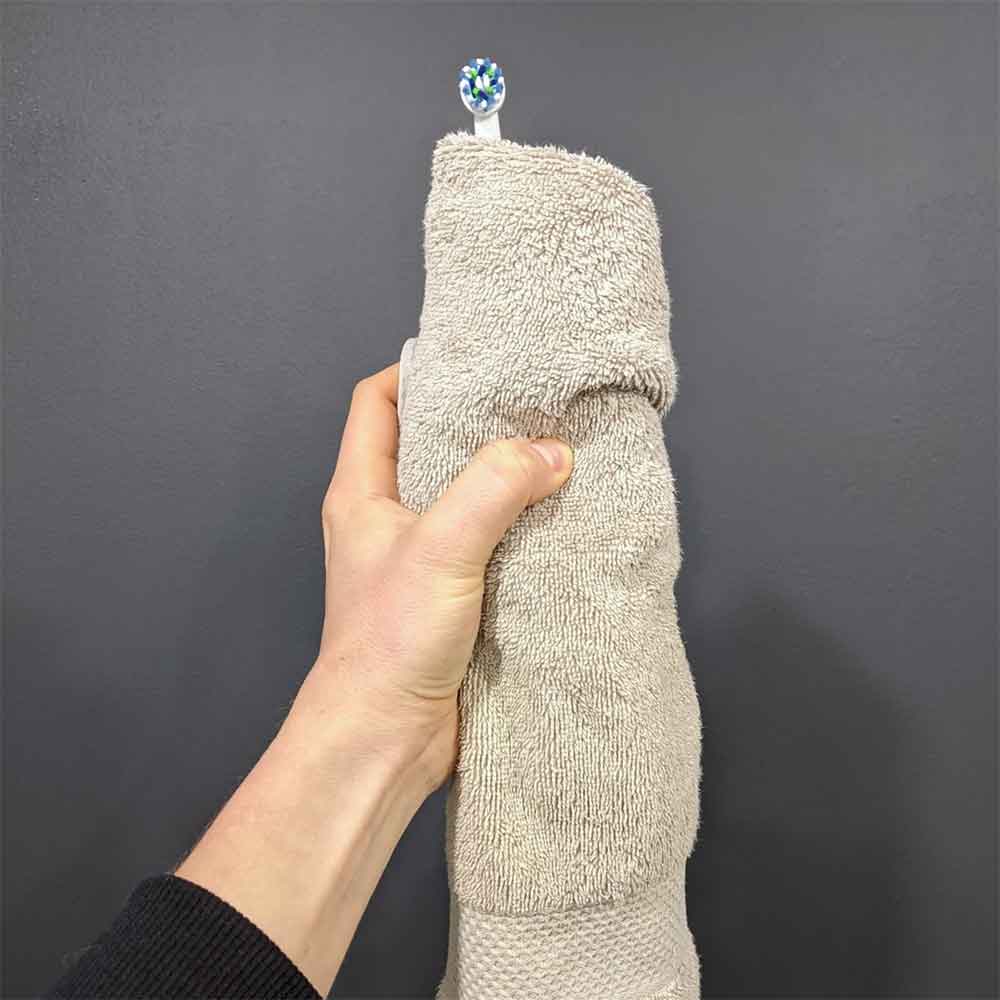
It is all very well wrapping the toothbrush in something, but it can make it harder to actually hold onto. And it can make it more difficult to move around the mouth.
It can hide other alerts the handle might give. One example is that the visible pressure sensor will not be visible when wrapped in a cloth.
You will also want to bear in mind that whatever you wrap around the brush you want to be clean as it's going near your mouth. You also want to ensure it does not interfere with the movement and operation of the brush. You don’t want a stray thread getting caught up in the brush head mechanism.
It is not a permanent solution either. In fact I know of no permanent solution to make the brush quieter other than switching to a sonic toothbrush.
Other factors affecting the noise
Brush head
It is the brush head that produces a large proportion of the noise. It is therefore important to consider the brush head that you use.
Not all brush heads are created equal.
My advice is to stick with the manufacturer's original brush head. Whilst this might not necessarily be the quietest, typically it will be. It will be of a good quality and not affect the performance of the clean.
More cost effective brush heads from other companies can be made to different standards. The construction will possibly be different and the fit to that handle might not be quite as snug.
This can mean the noise produced is greater than when the manufacturer original is fitted.
Putting the sound aside, the overall cleaning performance and longevity of the brush head may also not be as good.
Manufacturers own brush heads or not, it is important to replace your head approximately every 3 months. This is for hygiene reasons, but also because parts inside the head can potentially wear. Extended usage times may result in more noise.
Cleanliness
It might seem silly, but keeping your brush clean will help.
Dried toothpaste and gunk in and around the head as well as around the shaft can affect the performance. It may cause the brush head not to move quite as it should. Parts may not travel as freely or their path of movement might be disrupted in turn affecting the noise and efficiency with which they operate.
After each use, rinse the toothbrush head and handle and if possible dry off with a towel or at worst leave it in a well ventilated space.
If the brush does get a buildup of muck that needs removing, take some time to do the best job you can to keep it clean.

Damage
Most toothbrushes will in their life suffer the odd fall or may incur a bit of damage, be that intentional or not.
The brushes are designed, as best as possible to survive such a life, but they are not infallible.
The better the condition of the toothbrush the better it will perform, so do try to take care of it.
A fall from even a few inches could potentially cause a cable to come loose or a part to become misaligned inside the handle.
In many cases, there are microscopic tolerances and the smallest misalignment can cause parts to perform incorrectly or not move freely thus affecting the performance and potentially the sound.
If you notice any strange sounds or odd performance from your brush it may well pay to get it inspected. Do this if you can within the warranty period to limit any potential costs.
The age of the brush
As a general rule the average toothbrush appears to last around 5 years. Although many last a great deal longer.
Older models are more likely to make more noise, although this is not always the case.
Typically there shouldn’t be too much noise generated by the handle itself. But, with repeated use parts can wear and you may experience more noise from the handle.
Electric toothbrushes for the most part are not designed to be serviceable at home.
Authorised repair agents can repair them. The reality is it tends not to be economically viable.
If a toothbrush is old and making a lot of noise, it is best to replace it. Recycling the old one of course.
Battery compartment
It is not all that common, but those electric brushes with removable batteries might create a bit more noise. There tends to be a little more room within the body, allowing for more vibration and movement. Batteries can rattle causing a frustrating sound.
Open up the battery casing and make sure the batteries are making good contact and are as snug as they can be. Ensure any battery caps are screwed or pushed on as securely as they can be.
The room
Whilst it doesn't directly affect the actual sound that the brush itself makes, it can affect the perception of the sound.
A bathroom with lots of hard tiled and glass surfaces for example is going to make the sound seem much louder than if you were brushing your teeth in a room filled with sound absorbing soft furnishings.
Soft items like towels, dampen the sound. There is less reverberation of the sound waves and less echo.
I am not suggesting going to stand in the closet to brush your teeth, but you get the point.

this was super helpful. thanks for the review.
Hello, I would like an electric toothbrush that uses oral b toothbrush heads, as seen with the Oral-B 3500. Which is what a family member uses and I find it to be too loud. I would like to know if you have electric toothbrush recommendations that use that head but is quiet enough. I really dislike the 3500 due to that. If not do you have a few that also are well known and probably has some cheap knockoff heads online. Any that use the generic oral head would be the best. Price doesn’t matter but I would like it to be quiet, currently I use a Nevadent from Lidl. But its charging is bad. I would like a rechargeable one too.
Generally speaking, Sonic (vibrating) toothbrushes are quieter than Oral B-style (spinning) toothbrushes. Your best option here would be to look at the Oral-B iO Series. Some of those are about 10 decibels quieter than the 3500.
The cheapest quiet one is the Oral-B iO3. It is 64dB, whereas the 3500 is 73dB. They're still not as quiet as sonic toothbrushes, though. You can check the table above to see them listed in order of loudness.
There is a brand called Bitvae that makes an Oral-B style brush, called the R2, but we measured that at 75dB.
To me, the most important thing is to minimize vibrations to my hand holding the brush- I have not found a good guide on this. High sounds does not necessarily translate to high vibration. Which ones is best from this standpoint?
Hey. This is not something we have been asked about before and we don't have a guide on such.
I am not sure how we would measure the vibrations in the handle easily to be able to give any meaningful feedback.
There are some brushes where you can feel the vibration is a little less intense or feels different in the hand to others.
Even without testing I am not sure I could easily say this one is quiet and has little vibration.😬
I'm autistic so while the volume of the toothbrush isn't as important as its cleaning capability, it's still a big factor for me when choosing a new model. Thank you so much for this helpful guide.